
Key points
- BOEM recommended a two-zone Area Identification covering about 69.1 million acres around the Northern Mariana Islands, roughly doubling its prior 35.5 million acre eastern-only footprint.
- The eastern zone is tied to polymetallic nodules and ferromanganese crusts, while the new western zone targets more speculative polymetallic sulfide deposits closer to Guam.
- The move is not a lease sale or mining approval but advances the area into the next stage of federal review.
- Guam officials opposed the western addition, while CNMI leadership called for stronger science before any leasing decision.
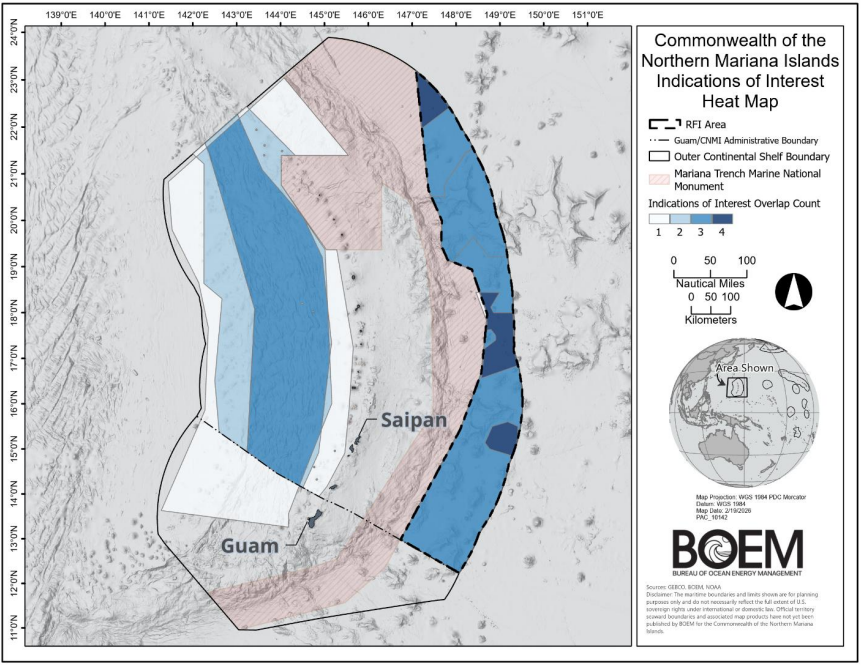
The U.S. Bureau of Ocean Energy Management has expanded the offshore minerals process around the Commonwealth of the Northern Mariana Islands by recommending a two zone Area Identification covering about 69.1 million acres. This is not a lease sale or a mining approval, but it is an important step because it defines the offshore area BOEM believes should move forward into the next stage of federal review.
Why it matters
The main change is simple. BOEM was previously focused on a single eastern area of about 35.5 million acres. It has now kept that eastern zone and added a second zone to the west, effectively doubling the footprint under consideration.
That shift matters because it turns what had been an eastern nodule and crust story into a broader two sided offshore minerals process. The eastern side is tied mainly to polymetallic nodules and ferromanganese crusts. The western side is tied mainly to polymetallic sulfide interest.
The geology
Geologically, the two zones are not equal. BOEM presents the eastern area as the more established regional target, based on existing USGS work on nodule and crust prospectivity. The western area is more speculative. BOEM points to the back arc basin setting, broader sulfide prospectivity in the region, and nearby hydrothermal vents, but also acknowledges that no direct fieldwork has yet been carried out there to identify polymetallic sulfide deposits.
That is an important distinction. The western zone is being advanced on geological inference and industry interest, not on a confirmed deposit.
The politics
The western addition also makes the process more sensitive politically because it lies much closer to Guam than the eastern side. BOEM received heavy public feedback raising concerns about environmental damage, sediment plumes, fisheries, tourism, Indigenous rights, cultural heritage, and regional consultation. CNMI leadership took a cautious position and called for stronger science and fuller review before any leasing decision. Guam officials were more directly opposed.
Key takeaways
• the offshore footprint has roughly doubled from about 35.5 million acres to 69.1 million acres
• the eastern zone remains the clearer nodule and crust story
• the western zone introduces a newer and more speculative sulfide angle
• BOEM is keeping the process alive, but it is not yet committing to a lease sale or mining approval
Bottom line
BOEM has materially broadened the CNMI offshore minerals process. What had been a single eastern area is now a much larger two zone federal review process. For industry, that keeps a major U.S. offshore critical minerals opportunity in play. For opponents, it means the fight is now moving into the environmental review stage.


