Key points
- The House Science Committee’s Environment Subcommittee held a two-hour hearing on deep-sea mining, featuring TMC CEO Gerard Barron, Saildrone VP Brian Connon, oceanographer Dr. Robert Ballard, and Oregon State ecologist Dr. Astrid Leitner.
- Barron argued the U.S. is 100% import-dependent for primary nickel, cobalt, and manganese, while China produces about 70% of rare earths and processes nearly 90% of critical minerals.
- The Clarion-Clipperton Zone reportedly holds 300 years of U.S. manganese consumption, 200 years of cobalt, and 100 years of nickel; TMC has spent $700 million and generated over a petabyte of environmental data.
- NOAA finalized a streamlined permitting framework in January 2026, and TMC was the first company deemed in compliance under Executive Order 14285.
The House Science Committee’s Environment Subcommittee held a two-hour hearing on deep-sea mining Wednesday, bringing together The Metals Company CEO Gerard Barron, Saildrone’s ocean mapping VP Brian Connon, legendary oceanographer Dr. Robert Ballard, and Oregon State deep-sea ecologist Dr. Astrid Leitner. What emerged was a picture of an industry with the science, the technology, and now the regulatory runway to move — if Congress gets out of the way.
Why it matters
The U.S. is finally moving. NOAA finalized a streamlined permitting framework in January. The Metals Company was the first company deemed in compliance. Executive Order 14285 — signed by President Trump in April 2025 — has created the conditions for an entirely new American industry. Wednesday’s hearing was Congress catching up to that reality, and the case for pressing forward was made with more force than the opposition could credibly answer.
The industry case
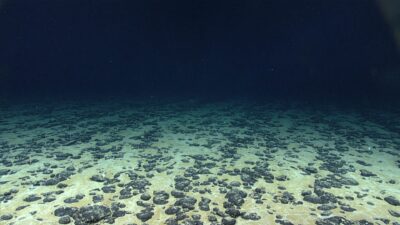
Barron made the supply chain argument as clearly as it’s ever been made in a Congressional hearing. The U.S. is 100% import-dependent for primary nickel, cobalt, and manganese. China produces roughly 70% of global rare earth supply and processes nearly 90% of critical minerals. The Clarion-Clipperton Zone contains, by Barron’s figures, 300 years of U.S. manganese consumption, 200 years of cobalt, and 100 years of nickel sitting on the ocean floor — four strategic metals in one place, at a scale no land mine can match.
His company has spent $700 million and generated over a petabyte of environmental data. That’s not a company cutting corners. That’s a company that has done the work. Modern collection technology, tested in a 2022 pilot running over 80 kilometers of track, leaves near-invisible ripples on the seafloor. Mud mobilization is down by an order of magnitude compared to 1970s systems. Microbes showed no measurable impact when researchers returned 12 months later. The science, Barron argued, is there. The regulatory framework, under the Deep Seabed Hard Mineral Resources Act, is there. What’s been missing is the political will — and the Trump administration has supplied it.
The science pushback — and its limits
Leitner raised concerns about data gaps and midwater plume discharge. These are legitimate research questions. But they are research questions, not stop signs. The executive order Leitner cited actually calls for responsible development alongside sustained scientific investment — not a moratorium. As Chairman Franklin pointedly noted during questioning, praising China’s research asset base doesn’t give Beijing a hall pass on environmental standards. The U.S. has rules. China operates largely without meaningful oversight in international waters. The choice isn’t between mining and not mining. It’s between American-regulated mining and a Chinese-dominated seabed.
When pressed, Leitner acknowledged she isn’t privy to what’s coming out of Chinese research. She acknowledged no one gets a hall pass. But the logical endpoint of indefinite delay is ceding the field to actors with far less regard for the environment than any U.S. company operating under NOAA oversight.
The Ballard factor
Ballard’s testimony was the most striking of the day — and not for the reasons the anti-mining members hoped. Yes, he urged more exploration. But his central revelation was that a recent NOAA expedition he led found a brand new rare earth deposit on ancient seamounts in American waters, shallower than the nodule fields anyone is currently targeting. His team goes back in June.
That’s not an argument against mining. That’s an argument for the exact kind of public-private exploration investment that makes American ocean science — and eventually American ocean industry — world-leading. Ballard himself said he wants all players at the table working together as Americans. He’s not opposed to the industry. He wants the U.S. to explore its own territory before someone else does.
The mapping gap is solvable — and fast
Connon’s testimony was the most actionable of the day and pointed squarely toward solutions. Autonomous uncrewed surface vehicles can close the mapping gap faster and cheaper than anyone previously thought possible. For the cost of one new ship, the entire unmapped U.S. EEZ frontier could be surveyed in 36 months. That’s not a decade of paralysis. That’s an aggressive, achievable near-term goal using technology that exists right now and is already deployed in the Mariana Islands alongside NOAA and the U.S. Navy.
His three asks of Congress were concrete: codify NOAA’s AUTO program, shift investment toward scalable uncrewed systems, and release the seabed mapping plan required by EO 14285. None of those asks require slowing the permitting process. They accelerate the knowledge base that makes responsible mining possible.
Key takeaways
- The Metals Company has $700 million in environmental research, a petabyte of data, and the first compliant permit application under the new NOAA framework. The scientific foundation for proceeding exists.
- China holds more ISA exploration licenses than any other nation, has 40+ research vessels to NOAA’s 15, and has been running deep-sea pilot processing plants since at least 2018. Waiting does not protect the ocean. It hands the ocean to Beijing.
- Modern nodule collection technology is measurably better than the systems that raised concerns in the 1970s. Real-world trial data — not lab models — shows manageable, localized impacts and early recovery signs.
- Autonomous mapping technology means the knowledge gap can be closed in years, not decades, at a fraction of the cost of traditional ship-based survey programs.
- A new rare earth deposit was just discovered in U.S. waters. American leadership in ocean exploration and American leadership in ocean resource development are not in conflict — they’re the same project.
Bottom line
The hearing made clear that the science has matured, the technology has improved, and the geopolitical case for moving is urgent. The critics raised familiar concerns — more research, more baselines, more time. But after 50 years of study, over 200,000 published papers on polymetallic nodules, and nearly a petabyte of real-world environmental data, the argument that we simply don’t know enough is wearing thin. China isn’t waiting. The minerals aren’t going anywhere. And for the first time in decades, the U.S. has a regulatory framework and an administration willing to use it. The window is open. The question is whether Congress has the will to walk through it.