Key points
- NMP answers questions raised at a media conference on the Sandpiper process and its environmental impacts.
- Topics covered include the transparency of the EIA, the dredging process, onshore handling of material and the toxicity of phosphate rock.
- The company describes the assessment as long, thorough and responsive to concerns raised.
During a recent media conference, Namibian Marine Phosphate (Pty) Limited (“NMP”) received and responded to specific questions in relation to the Sandpiper Project processes and related environmental impacts. The process questions included the transparency of the Environmental Impact Assessment (“EIA”), the dredging process, the handling of materials onshore, and the toxicity of the phosphate rock.
Environment Impact Assessment Process
The EIA process has been a long, thorough and comprehensive process – throughout which NMP has been both transparent and responsive to all concerns raised. The EIA and Environmental Management Plan (“EMP”) were compiled in compliance with the requirements of the Environmental Management Act 2007 (“EMA2007”) and the conditions of ML170 mining license, incorporating the required consultative interactions at various levels with registered interested and affected parties, including public, stakeholders, and government representatives. Anyone wishing to read and further understand the factual details of the environmental impact can freely visit the offices of the Environmental Commissioner or the NMP website (www.namphos.com) where the reports pertaining to the EIA are publically available.
Has NMP completed an EIA?
Yes. The Environmental Clearance Certificate (“ECC”) application process itself has taken over 6 years to date, and has faced challenges similar to what the Uranium Industry faced when entering Namibia.
What was the conclusion of the EIA?
The EIA, the supporting independent expert reports, and the external reviewers’ reports all collectively conclude that the Sandpiper Project will NOT HAVE A SIGNIFICANT IMPACT ON THE ENVIRONMENT OR COMMERCIAL FISHING INDUSTRY.
Did NMP conduct specialist reports?
Yes. 26 specialist reports have been completed assessing various aspects of the potential environmental impact of the proposed dredging operations in ML170.
How many consultants conducted the studies?
37 independent experts from a range of environmental consultancies have contributed to the environmental studies completed as part of the ECC application process. How were the consultants chosen?
Each of the experts selected by the appointed Environmental Assessment Practitioner (“EAP”) were specifically chosen for their expertise and their overall understanding and experience in relation to the Benguela Current System, where the Sandpiper Project is located.
Who paid for the consultants?
It is a requirement of the law in Namibia under the provisions of the EMA2007 that the Proponent (in this case, NMP) cover the cost of the ECC application and related studies.
Did NMP influence the consultants?
No. In accordance with the EMA2007, the EIA process is managed through the appointment of a professionally qualified and independent EAP. Professional and reputable consultants are governed by the relevant standards and codes of conduct of their professional associations.
Did NMP hold public and stakeholder consultations?

Yes. On 18 occasions, NMP has held consultative meetings with registered interested and affected parties, including stakeholders, the general public, and governmental and regulatory parties.
1 | P a g e
Operational Processes
Marine phosphate mining comprises two specific processes namely 1) dredging and 2) sediment processing in order to produce a saleable phosphate product. A standard dredging system is used to recover the sediments containing phosphate sand from the seabed. While for shore-based sediment processing, a mechanical separation system with sea water is used to produce a phosphate concentrate, which forms the final product.
Dredging
NMP have contracted Jan de Nul (“JDN”), an internationally renowned Belgium registered, dredging company, who ensure that for all of their projects there is a sustainable Quality, Safety and Environment Plan. JDN are also ISO 9001, ISO 14001, OHSAS 18001 and VCA certified. The dredging process itself comprises a standard trailing suction hopper dredger (“TSHD”), which will be carried out using the JDN TSHD ship, Cristóbal Colón. This ship has a proven track record having operated on numerous dredging projects internationally.
How does dredging work?
Dredging is a standard, internationally used process that involves lowering a suction pipe to the seabed to suck up the phosphate-bearing sediment. This system is quite similar to domestic vacuum cleaning. While the draghead is on the seabed, the ship will maintain a low trailing speed, which is similar to bottom fish trawling.
What happens to the sediment that is sucked up?
The sediment dredged from the seabed will be pumped into the ship’s storage tanks as a soil/water mixture monitored and controlled by specialised operators controlling the highly computerised dredging process.
Will there be plumes of fine sediment as a result of the dredging?
Yes. The discharge of a sediment plume occurs in all dredging operations. The excess water is discharged through the bottom of the ship at a depth of 10-15m, which greatly improves the dispersion and dilution of discharged water. The EIA plume dispersion modelling work indicates these plumes dissipate within a relatively short period (between dredge cycles) due to the ocean currents.
Is it a continuous dredging process?
No. Dredging operations are not continuous. Each episode occurs for a period of approximately 16 hours at a time, and at a frequency of 3.5 times a week on average.
Onshore Sediment Processing
Where is the dredged sediment offloaded?
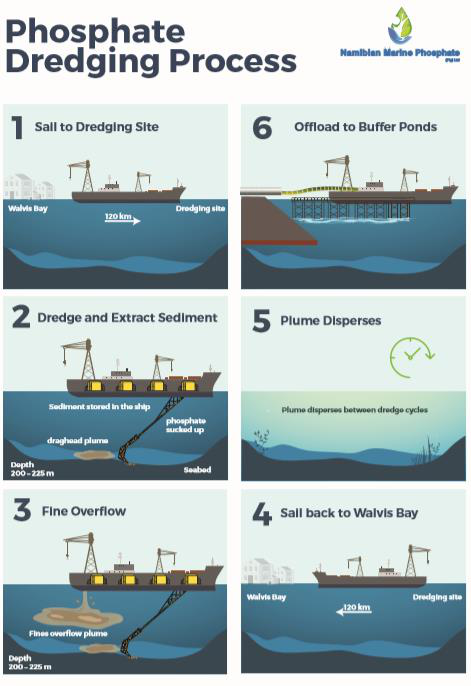
The current plans are based on the ship utilizing the facilities at the new SADC bulk materials terminal in Walvis Bay to offload the phosphate sediment, which will be pumped ashore into buffer ponds for storage prior to processing.
How is the phosphate sediment processed?
From the buffer ponds, the phosphate sediment is then pumped to the processing plant, where it will be processed into saleable concentrate phosphate product. The mechanical process comprises a series of screens, cyclones, and spirals where the coarse fractions (waste) will be removed leaving a saleable phosphate rock grading at 28% P2O5. Suitable land sites for the processing plant are being considered and will form part of the ECC application for the land-based operations.
How much of the dredged sediment is saleable?
From the original material dredged to the final product produced for sale, the recovery is 60% of the total dredged sediment, which is saleable as product once processing has been completed.
2 | P a g e
What happens to the waste product from the processing plant?
As with all mining projects there is an element of waste material that will need to be stored in a safe and environmentally sound environment. For this, a tailings storage facility will be built, managed, and environmentally monitored in accordance with relevant Namibian regulation and specifications as well as international best practices.
Are chemicals used during processing?
No. The processing of marine phosphate to produce concentrate is a mechanical process, not an industrial chemical process.
Toxicity of the Phosphate Mineral Sand
Phosphate has been accumulating in the seabed sediments in various forms along the West Coast marine shelf for millions of years. Fishing and the associated disturbance of seabed sediments by bottom trawling has been carried out in that same area for over 100 years and, to date, there are no reported ill effects from the consumption of fish from the Namibian marine environment.
This is important as the dredging that NMP has planned covers only a tiny area (less than 0.1%) of what are deemed the fishing grounds. During the decades of bottom trawling in that same area, which creates larger plumes than anticipated with phosphate dredging, the fish have not become infected.
In the Verification Report of 2014, the studies concluded that the phosphate mineral itself occurs as an insoluble component in the grains of pelletal phosphate sand and remains so even if the sediment is disturbed. Elutriation tests were conducted on sediments from the Sandpiper ML170 site in 2014 to assess the toxicity of related heavy metals in the surface and sub-surface sediment. The results showed that negligible proportions of heavy metals entered the dissolved phase and concluded that they do not represent a toxicity risk either as they occur on the seabed or following physical disturbance of the sediment.
The risk of toxicity to fish by direct or indirect ingestion of suspended sediment was also considered. However, the proposed dredging operations in the ML170 site are not expected to increase exposures of benthic fauna to heavy metals such as cadmium over and above that which occurs naturally in the region. This supports the assessment of toxicity risks in the EIA of 2012.
It has been assessed by qualified environmental professionals that the proposed scale of operations for the Sandpiper Project will therefore not harm the fishing industry and will not have a significant impact on the surrounding marine environment in the Benguela Current Large Marine Ecosystem.
NMP and the Sandpiper Project will not kill the fishing industry and the emotive statements claiming this are unfounded in fact or evidence.