Key points
- NMP describes Namibia as holding one of the world’s largest undeveloped phosphate resources.
- The company says a phosphate and fertiliser industry would create jobs, support services and export earnings.
- Sandpiper is presented as a first building block for a Namibian fertiliser industry.
With one of the world’s largest undeveloped phosphate resources, establishing a phosphate project and fertilizer industry in Namibia will offer many benefits. It will position Namibia as an exporter of phosphate and fertilizer products, see an increase of in-country agricultural activity, create much-needed employment opportunities, require supporting industry services, and offer numerous economic benefits (click for info). The Sandpiper Project (“NMP” or “NMP’s Project”) could be the first building block for developing a fertilizer industry in Namibia.
Uses of Phosphate in Namibians’ Daily Lives
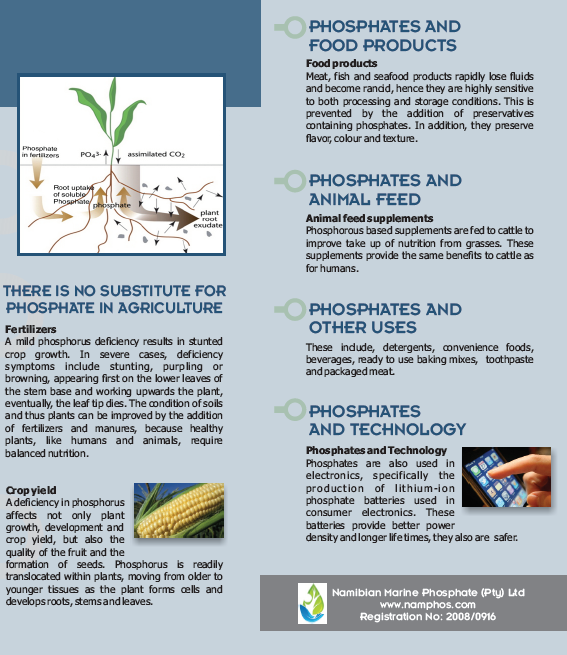
Namibians use phosphate every day, often without realizing it. Phosphate is a critical component in fertilizers and animal feed supplements. In addition, phosphate is found in a variety of consumer products (such as soft drinks, toothpaste, health products, cleaning products, etc.), and is used in industrial and manufacturing processes. See attached brochure for more information.
Phosphate is also Beneficial for the Climate: It Helps Prevent Deforestation
Phosphate allows for increased crop yields and thus productivity on farmland, which reduces the need for further deforestation, maintaining the integrity of global forests. As a result of sustainable agricultural productivity, an estimated 1 billion hectares of land globally has been preserved between 1961-2005.
Namibia Imports Large Quantities of Fertilizer at High Cost, Resulting in Less Agricultural Activity
When farming for crops, fertilizer is applied to improve the crop yield per hectare, which is now a well-accepted practice with sound scientific support; and, phosphate is also critical for plant and animal growth.
Despite having one of the largest known phosphate resources in the world, Namibia still imports the majority of the fertilizer products needed to underpin its agricultural industry, most of which comes from South African manufacturers. Recently, a N$19.8 million contract to supply fertilizer was awarded to South African company Kynoch by the AgriBusDev Agency in Namibia (Article, Mar 30, 2020, Observer National).
Also, due to the high import costs of fertilizer products, the per capita (per person) fertilizer consumption in Namibia is low as compared to other countries that have developed phosphate mineral resources, such as South Africa, Egypt, and Morocco.
Typically, the large proportion of subsistence farmers in Namibia cannot afford commercial fertilizers.
NMP’s Project could Lead Namibia to Become Exporters of Fertilizer, aiding in Global Food Security
The development of Namibia’s world-class marine phosphate mineral resources along with a fully integrated phosphate and fertilizer industry would be in line with Namibia’s national development initiatives (Vision 2030 and Harrambee). These initiatives aim to see the evolution of integrated industrialization in Namibia, adding value to the upstream raw materials through downstream in-country processing.
Establishing a fertilizer industry would enable an increase of in-country agricultural productivity, and also see Namibia become an exporter of phosphate and fertilizer, helping the world achieve food security. In fact, the Sandpiper Project’s phosphate concentrate has been assessed by institutions internationally as being commercially viable and cost-effective for use as:
1. a direct application fertilizer, 2. single super phosphate, and 3. a blend to more expensive forms of fertilizer.
Namibia’s Phosphate Resource is Sustainable for Future Generations – over 100 years!
Namibia has one of the largest undeveloped phosphate resources in the world, estimated to be more than 4.0 billion tons, of which the area of highest concentration (>10% P205) is limited and predominantly located off the southwest coast of Walvis Bay in water depths of 200-300m (see image below). Currently, there are two granted mining licences which cover most of the defined phosphate resource area: ML170 (NMP) and ML 159 (LL Namibia Phosphates Pty Ltd).
A Definitive Feasibility Study (“DFS”), completed by NMP for the Sandpiper Project in 2012 and updated in 2013, concluded that the Sandpiper Project is technically, economically, and environmentally viable. Based on a commercially viable cut-off grade of 15% P205, the DFS indicated there is sufficient phosphate resource within ML170 to sustain mining operations and benefits for future Namibian generations for more than 100 years.
26 Scientific Studies Conclude: No Significant Impact on the Marine Environment
In addition to the DFS, independent scientists and specialists have concluded that, at the proposed scale of operations:
- the Sandpiper Project will have no significant impact on the marine environment,
- fishing and phosphate can co-exist, and
- phosphate mining will not kill the fishing industry. These conclusions are based on 26 independent specialist environmental studies that were completed as part of the Environmental Impact Assessment process. Supporting Namibia’s mandate to protect the ocean, NMP enlisted internationally renowned scientists to conduct these studies, costing over N$28.7 million, and ensured all the experts have worked in some capacity on the Benguela Coastal System. ###