Key points
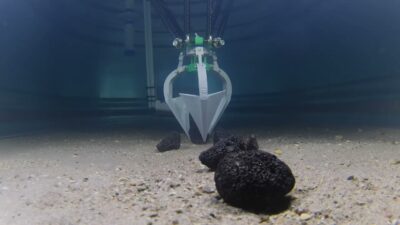
- Impossible Metals’ Eureka Collection System selectively recovered polymetallic nodules with a fully autonomous robot in the Clarion-Clipperton Zone
- The scientific dive went below 4,000 meters (2.5 miles) and recovered about 450 grams of nodules for Viridian Biometals’ bacteria research
- US patent 12,704,065, granted August 11, 2026, covers the hovering, buoyancy-lifted, nodule-selecting design
- Eureka III goes before an independent team aboard Germany’s RV SONNE in 2027 under a BGR impact study
PITTSBURGH–(BUSINESS WIRE)–Impossible Metals today announced that its Eureka Collection System™ has become the first in the world to selectively recover polymetallic nodules from the deep ocean using a fully autonomous underwater robot, completing a scientific dive in the Clarion-Clipperton Zone at a depth of over 4,000 meters (2.5 miles).
It is the first time ever a fully autonomous underwater robot has selectively collected nodules, and done so gently hovering above the seabed without a riser pipe.
The dive recovered approximately 450 grams of nodules, which will be used by Viridian Biometals to study bacteria populations residing in the nodules. The dive was conducted as marine scientific research, and the quantity of nodules collected reflects that purpose.
Eureka hovers above the seabed rather than driving across it. A buoyancy engine allows the vehicle to lift its payload by harnessing the physics of water displacement, which removes the need for a riser pipe and the process-water discharge and cost that comes with one. As it works, the system’s perception layer identifies visible life on and around each nodule and leaves those nodules where they are, selecting only from the remainder.
The technology is protected by US patent 12,704,065, granted on August 11, 2026 from an application with a March 2022 priority date and naming company co-founders Oliver Gunasekara and Jason Gillham as inventors. Its claims describe the elements of this dive: a vehicle that hovers rather than contacting the seabed, buoyancy-driven vertical movement, robotic arms that select individual nodules, and a perception system that identifies nodules carrying visible fauna and leaves them in place. Corresponding applications are pending worldwide.
“The purpose of the dive was to sample a few nodules to help advance understanding of bacterial populations in nodules. To see the entire system work in the middle of the Pacific, deeper than the Titanic, which was incredible. The questions we set out to answer are answered. Eureka is proven, patented, and ready. And because it scales by adding robots one at a time rather than building substantial infrastructure all at once, it has a fundamentally different cost structure from anything built around a riser and a fleet of surface ships. What remains is scaling and manufacturing, not invention,” said Steve Curnutte, Executive Chairman and CEO of Impossible Metals.
Impossible Metals will provide a robots-as-a-service solution to the industry. The company is partnering with licensed resource holders (contractors) to supply and operate the Eureka Collection System.
Impossible Metals investors include In-Q-Tel (IQT), the strategic investor for the US intelligence and national security community and the Smith family of FedEx.
“Our father cared about securing nodules for American industry and national security. My siblings and I carried that legacy when we invested in Impossible Metals’ next gen robotics, and especially their sustainable approach to the ocean,” said Richard Smith, Chief Executive Officer, FedEx Airline, and Chief Operating Officer, FedEx International.
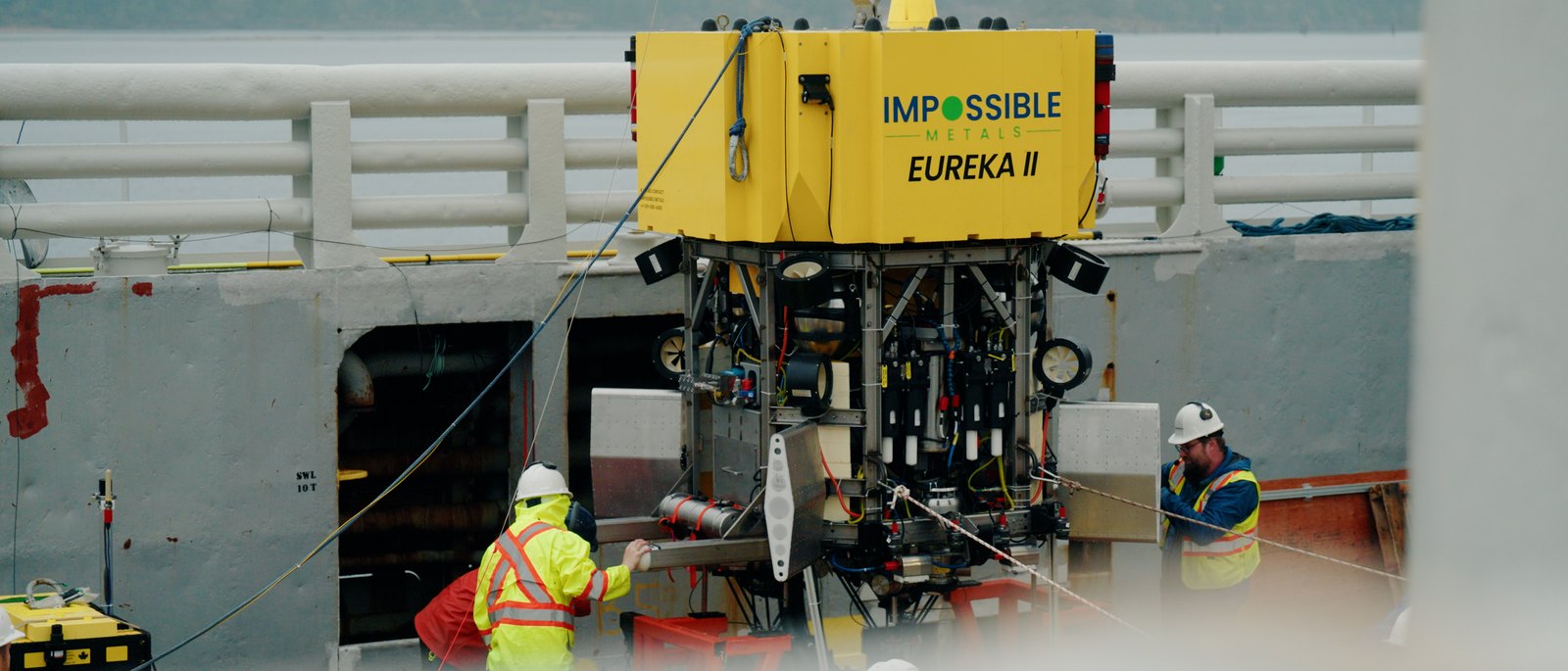
All scientific data collected during the dive will be published openly. Impossible Metals did the same after its Eureka II dives on the Blake Plateau two years ago, publishing the full data set and linking it from the company website.
In 2027 the company will put Eureka III, the scaled up version, in front of an independent scientific team aboard the German research vessel RV SONNE, under an environmental impact study initiated by Germany’s Federal Institute for Geosciences and Natural Resources (BGR). Impossible Metals also works with a standing group of nine independent scientists, convened on terms that leave them free to disagree with the company in public.
Viridian Biometals is a research partner of Impossible Metals, working on bacterial approaches to recover metals from polymetallic nodules that use less water, less energy, and no acid. The research program is the reason this dive was undertaken, and the recovered material is being studied under that program.
About Impossible Metals
Impossible Metals is an American marine-technology company. It has developed the Eureka Collection System, an autonomous robotic platform that uses AI and precision robotics to map, study and monitor the deep ocean and to selectively collect nodules rich in critical minerals. The data and material Eureka gathers are made available to scientists studying the deep sea, so that a site is understood before it is ever developed.