Key points
- Reaching the Mohorovicic discontinuity requires a total drill string length of 11,000 meters.
- The design called for long endurance, large variable load, strong sea-condition adaptability and excellent positioning to hold station on site.
- The team ran weight and center-of-gravity control through all design stages with a management and early warning mechanism and monthly reporting.
- Chief designer Zhang Haibin of CSSC’s 708 Research Institute led the fully independent domestic development route.
Editor’s note: On November 17, the Mengxiang (Dream), China’s first ocean drilling vessel, officially entered service. From project approval and feasibility work through to completion and entry into service, the organizations involved in its research and construction spent ten years breaking through numerous core key technologies to develop an ocean drilling vessel with fully independent intellectual property rights. This series from CSSC reports on how the participating organizations built the vessel and advanced science and technology innovation.
Why 11,000 meters? To drill down to the Mohorovicic discontinuity, the total drill string length needs to reach 11,000 meters.
How is an 11,000 meter drilling capability achieved? Put simply, in high winds and heavy seas, the ship has to stay steady.

In design terms, the vessel needs long endurance, a large variable load, strong adaptability to sea conditions, excellent positioning capability and high drilling efficiency, so as to maximize the operational window. In poor sea conditions it cannot simply pull the drill string and leave; instead, it has to hold station steadily on site. That is how Zhang Haibin, deputy chief engineer of the 708 Research Institute of China State Shipbuilding Corporation (CSSC) and chief designer of the Mengxiang ocean drilling vessel, describes the requirement.
To keep the ship steady, how are weight and the center of gravity controlled?
The Mengxiang project committed from the outset to a fully independent domestic development route, carrying out research and design from scratch, from basic design through detailed design to construction.
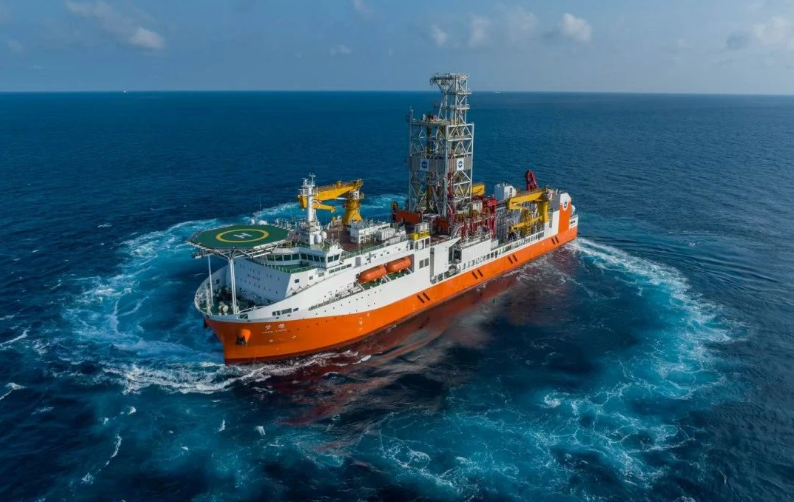
One of the greatest difficulties the design team faced during development was how best to control weight and the center of gravity. Integrating four operating modes and three coring methods meant meeting the design requirement for a large variable load, and the weight and center of gravity determined whether the Mengxiang’s overall performance and operational variable load targets could be achieved.
The project team ran weight and center-of-gravity control through the entire process of preliminary design, detailed design, production design and construction, and established a weight and center-of-gravity management and early warning mechanism with monthly reporting. In the preliminary design stage, multiple design options were evaluated and optimized; in the detailed design stage, equipment weight, structural weight and outfitting items were controlled; in the production design stage, piping and cable runs were optimized; and during construction, work was strictly required to follow the drawings, with close tracking and monitoring.
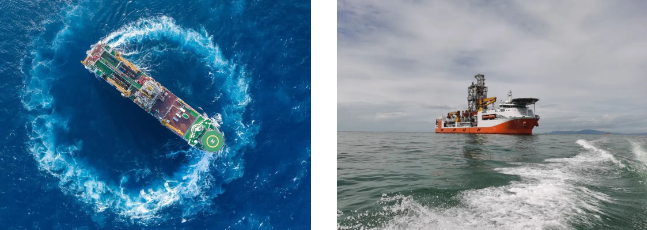
As delivered, the Mengxiang’s lightship weight came in 1% below the design value, the height of the center of gravity was reduced by 2%, and the longitudinal and transverse deviation of the center of gravity was held within 0.2%, fully achieving the overall performance and variable load targets.
For steady positioning, how does the vessel hold station? Environmental conditions in the deep ocean are harsh. The better a vessel can cope with severe sea conditions, the larger its effective operational window, and only by extending the drilling vessel’s operational window can the goal of drilling to the Mohorovicic discontinuity be reached sooner.
The Mengxiang can carry out drilling operations in sea state 6, significantly extending its operational window. It is fitted with an advanced DP-3 dynamic positioning system that automatically adjusts the steering and thrust of the seven thrusters beneath the hull to counter the wind, wave and current loads acting on the ship, keeping the vessel in position at sea. In addition, optimization of the hull form and loading keeps the natural period of the ship’s vertical motion as far as possible from wave periods, minimizing vertical motion at sea.