Key points
- Marine ferromanganese crusts and phosphorites can be enriched with valuable minerals and are targets for seabed mining, and they also serve as hard substrate for deep-sea fauna.
- New research from Scripps Institution of Oceanography and USGS analyzed the isotopic compositions of invertebrates living on those hardgrounds.
- Substrate type, depth and dissolved oxygen all shaped trophic structure, with greater trophic diversity on ferromanganese crusts and more specialized communities on phosphorites.
- The study area, the Southern California Borderland, is not currently targeted for mineral resource development, so the work provides baseline data for regions where mining may be pursued.
Marine ferromanganese crusts and phosphorites can be enriched with valuable minerals, and are therefore targets for seabed mining development. These minerals also serve as hard substrate for deep-sea fauna to live on and around. Thus, understanding potential impacts of extraction of these minerals requires research focused on the ecosystems that depend on these hardground habitats.
New research from Scripps Institution of Oceanography and USGS, aimed at filling knowledge gaps regarding macro and megafaunal invertebrates that inhabit these hardgrounds, focuses on the role these organisms play in nutrient cycling, bolstering the resilience of deep-sea communities. Understanding this role is crucial, particularly as these communities face threats of ocean deoxygenation, overfishing, in addition to the potential impacts of mineral extraction.
By analyzing the isotopic compositions of invertebrates on these hard substrates, the researchers found that substrate type, depth, and dissolved oxygen levels all play key roles in shaping the trophic structures of these deep-sea communities. Specifically, the study found that macrofaunal isotopic values varied with substrate type, with a greater diversity of trophic interactions observed on ferromanganese crusts, while phosphorites hosted more specialized communities.
Additionally, the research found a correlation between megafaunal isotopic values and their proximity to the shore. Offshore invertebrates were found to rely more on phytoplanktonic production than their inshore counterparts, indicating that location is also a key factor in determining food sources and ecological dynamics. The findings underscore the importance of considering variability in environmental context on small regional scales when evaluating the possible impacts of extracting these minerals to deep-sea ecosystems.
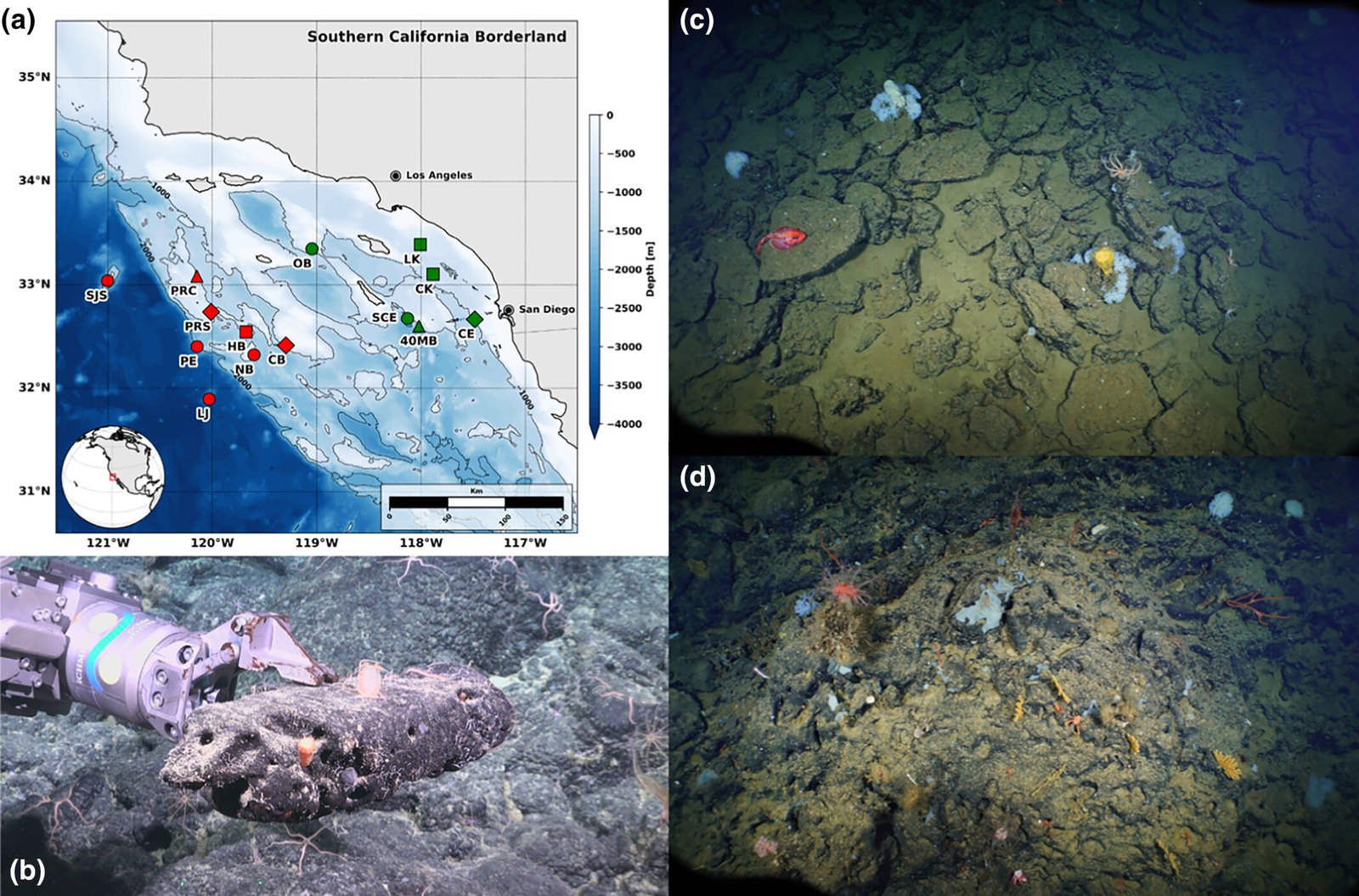
Although the study area, Southern California Borderland, is not currently targeting for mineral resource development, the research is timely as it provides essential baseline data that could inform future conservation and management strategies, as well as a valuable reference study for regions where deep-sea mining of ferromanganese crusts and phosphorites may be pursued.
As the demand for rare and valuable minerals continues to rise, studies like this one provide policy makers and stakeholders with much needed scientific information regarding biodiversity and ecological function associated with these hardground habitats that will be impacted by extraction of deep-sea mineral resources, should it ever occur.
Read the study, Invertebrate trophic structure on marine ferromanganese and phosphorite hardgrounds, in Limnology and Oceanography.
Related studies: