Key points
- USGS analyzed hydrothermal iron and manganese oxide samples collected from the Amerasia Basin in the Arctic Ocean, a region crossed by tectonic faults.
- The minerals formed roughly 8 to 4 million years ago, although no hydrothermal activity was known in that part of the Arctic Ocean at the time.
- The study proposes that frictional heating from tectonic faulting drove hydrothermal fluid circulation, with the faults acting as channels for the heated fluids.
- Amy Gartman, USGS Research Geologist and co-author, said the discovery broadens understanding of marine mineral formation.
A new study from USGS describes a previously unknown process of marine mineral formation in the Arctic Ocean, driven by frictional heating along tectonic faults rather than by hydrothermal activity.
In the study, scientists analyzed hydrothermal iron- and manganese-oxide samples collected from the Amerasia Basin in the Arctic Ocean, a region crisscrossed with tectonic faults. They found that these minerals formed in the recent geologic past, approximately 8–4 million years ago—a surprising discovery, given that no hydrothermal activity was known to occur in this part of the Arctic Ocean during this time period.
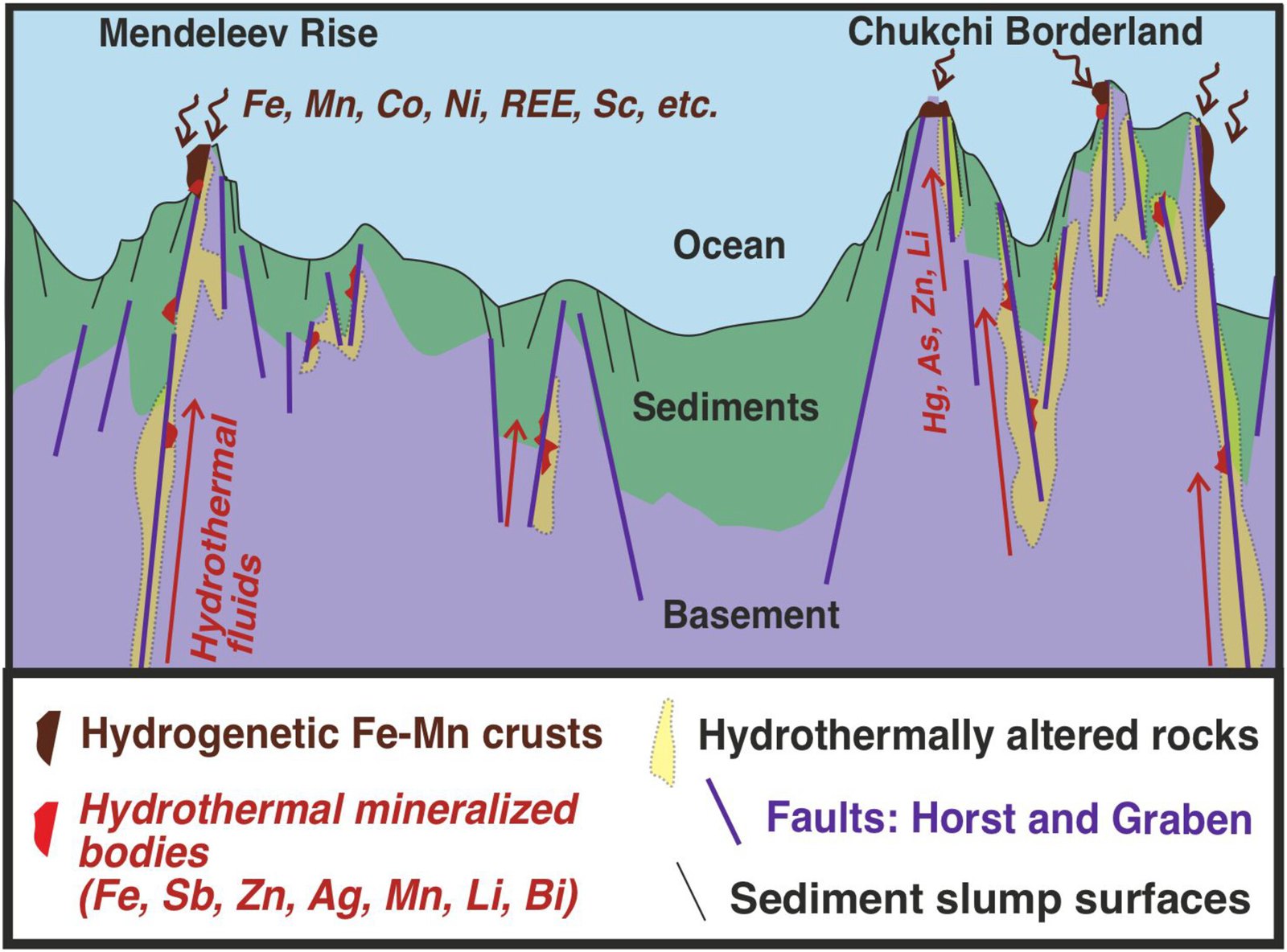
Hydrothermal activity—usually driven by seawater heated by the Earth’s internal energy—has long been associated with volcanic regions. But this new finding proposes a different process: frictional heating caused by tectonic faulting. As faults in the Earth’s crust ground against one another, the friction may have generated enough heat to drive hydrothermal fluid circulation, resulting in mineralization. The study proposes that these faults likely served as channels, allowing the heated fluids to rise and interact with ocean water, eventually forming minerals.

Regional location map and bathymetry of the Arctic Ocean with the study area delineated by the black rectangle.
Schematic deposit model showing formation of hydrothermal Fe- and Mn-oxide deposits at depth along faults during the Neogene (∼8.5–4.8 Ma) from ascending hydrothermal fluids driven by frictional heating and other fault-related processes.
Not only do these mineral formations challenge previous assumptions about geologic processes in the Arctic, but their unique composition also sets them apart from other marine minerals found in the region. Differences in their mineralogy and element composition indicate they were formed under distinctive conditions, driven by specific physical and chemical interactions beneath the seafloor.
“This discovery broadens our understanding of marine mineral formation, highlighting complex geological processes in the Arctic Ocean that were previously unrecognized,” said Amy Gartman, USGS Research Geologist and co-author of the study.
Read the study, Neogene hydrothermal Fe- and Mn-oxide mineralization of Paleozoic continental rocks, Amerasia Basin, Arctic Ocean, in Geochemistry, Geophysics, Geosystems.