Key points
- The vehicle, developed by the 702 Research Institute of China State Shipbuilding Corporation, completed sea trials near Lianyungang with support from the Taihu Laboratory Lianyungang Center.
- Trials covered deployment and recovery at sea, seabed path planning, autonomous driving, and cutting, suction and collection of pre-placed minerals.
- The mining vehicle is 8.2 meters long, 3.9 meters wide and 3.5 meters high, and weighs 21 tonnes in air.
- Deep-sea polymetallic sulfides are rich in copper, zinc, iron, lead and precious metals, with contained metal resources more than 600 times known land reserves of volcanogenic massive sulfides.
A deep-sea polymetallic sulfide mining vehicle developed by the 702 Research Institute of China State Shipbuilding Corporation (CSSC) has successfully completed sea trials in waters near Lianyungang. The trials were supported by the Lianyungang Center of the Taihu Laboratory of Deep-sea Technological Science.
During the trials, the project team worked through severe cold and high winds to complete the planned test items, including deployment and recovery of the heavy equipment at sea, seabed path planning and autonomous driving, and the cutting, suction and collection of minerals pre-placed on the seabed. The tests verified the safety and reliability of underwater operations by heavy-duty deep-sea mining equipment and provided experience and technical support for the vehicle’s subsequent sea trial missions.
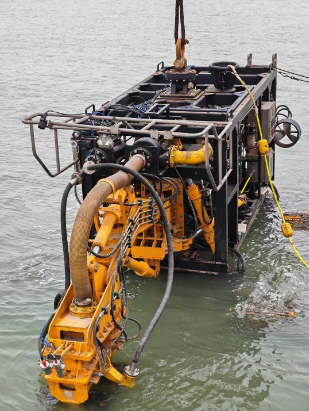
The mining vehicle tested is 8.2 meters long, 3.9 meters wide and 3.5 meters high, and weighs 21 tonnes in air. Its development broke through key technologies including automatic attitude orientation control during underwater deployment and recovery, high-power deepwater hydraulic drive, signal transmission and intelligent control, and three-dimensional digital twin visualization. The team developed a swing-milling excavation head, a four-track suspension chassis and an integrated control system with autonomous driving capability, solving the problems of excavating hard mineral deposits, traversing steep slopes and remote centralized control.
China’s marine science and technology is accelerating its progression from deep-sea access and deep-sea exploration toward deep-sea development. Deep-sea polymetallic sulfides are a deep-sea mineral resource rich in copper, zinc, iron, lead and precious metals including gold, silver and platinum group metals. Their contained metal resources are more than 600 times the known reserves of volcanogenic massive sulfides on land, and the copper resources alone could sustain more than 6,000 years of production at current rates.
The successful completion of these shallow-sea trials provides valuable data for the research and design of an integrated deep-sea polymetallic sulfide mining system, and marks an important step in moving heavy-duty deep-sea mining vehicles from research toward engineering application, helping to position China at the forefront of commercial extraction of deep-sea mineral resources.