Key points
- The Hunan provincial major project on key equipment technology for deep-sea mineral extraction passed acceptance on June 17 in Changsha.
- The panel concluded the project overcame numerous technical challenges and completed its planned R&D tasks.
- The project was jointly led by Hunan University and CRIMM with 7 Hunan-based institutions, led by academician Ding Rongjun.
- CRIMM led sub-projects on geological exploration and on mineral collection and transport at 3,000 to 6,000 meters.
On June 17, the Hunan provincial major science and technology project “Research and Demonstration Application of Key Equipment Technology for Deep-Sea Mineral Resource Extraction” passed its comprehensive acceptance review in Changsha, organized by the Hunan Provincial Department of Science and Technology. The acceptance panel, led by Liu Feixiang, chief scientist of China Railway Construction Heavy Industry Corporation, concluded that the project had overcome numerous industry technical challenges, produced a series of equipment technology results, and successfully completed its planned research and development tasks.
Qing Jianbo, Party secretary and director of the Hunan Science and Technology Affairs Center, Li Kenli, vice president of Hunan University, Zhuo Xiaojun, general manager and deputy Party secretary of the Changsha Research Institute of Mining and Metallurgy (CRIMM), and Li Maolin, chief technology expert of China Minmetals, attended the meeting. On behalf of the lead unit, Zhuo Xiaojun thanked the provincial science and technology department for its support and the review experts for their guidance, congratulated the project team led by academician Ding on completing the project, and said CRIMM would continue to increase and deepen its research investment in deep-sea mineral resource development, aiming to set an example in Hunan and nationally and to contribute deep-sea technology strength to Hunan’s development goals and Changsha’s ambition to become a global R&D center city.
The project was jointly led by Hunan University and CRIMM, and undertaken together with CRRC Zhuzhou Times Electric, Hunan Xiangtou Goldsky Technology Group, Central South University, Hunan University of Science and Technology, and the National University of Defense Technology, a total of 7 Hunan-based institutions. The project leader was Ding Rongjun, academician of the Chinese Academy of Engineering, chairman of the academic committee of the State Key Laboratory of Deep-Sea Mineral Resources Development and Utilization, and professor at Hunan University. CRIMM led sub-project 1, “Key Technology and Equipment for Deep-Sea Mineral Resources and Geological Exploration,” and sub-project 2, “Key Technology and Equipment for Mineral Collection and Transport at 3,000-6,000 Meters,” undertaking key equipment development, research project management, and organization and implementation for both sub-projects.
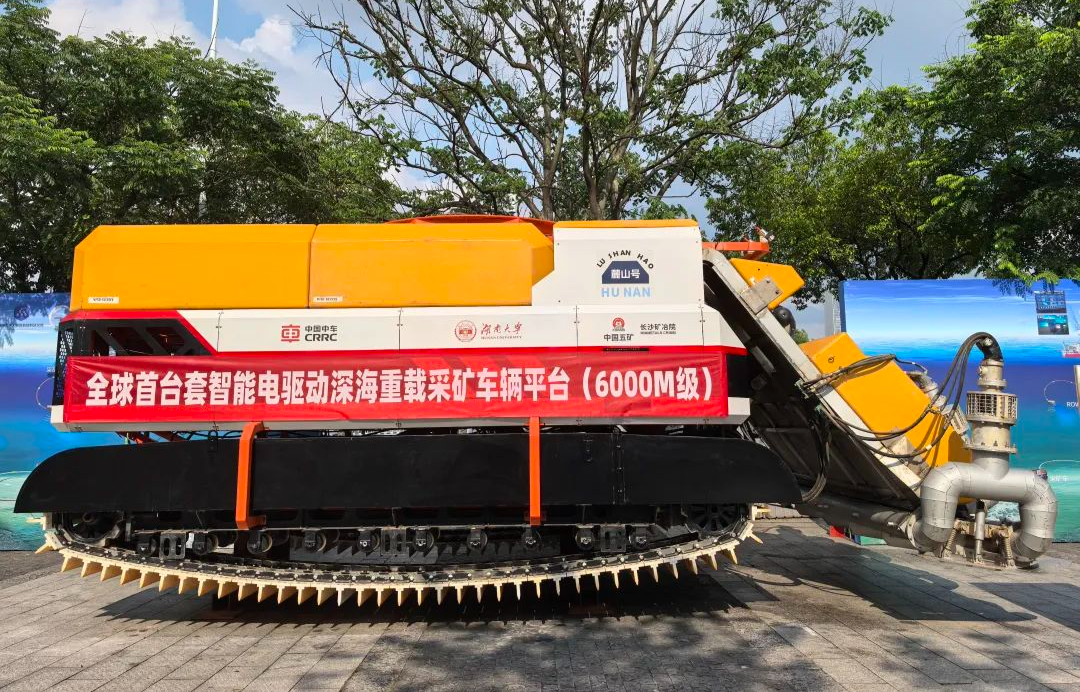
Oriented toward deep-sea mineral resource development as a future national industry, the project focused on key operational stages of exploration, collection, and transport of deep-sea minerals at depths of 3,000 to 6,000 meters, following trends in digitalization, electrification, and intelligence. It tackled a number of core and common key technologies and produced six major sets of equipment, including the world’s first 6,000-meter-class intelligent electric-drive deep-sea heavy-duty mining vehicle platform, with some results filling international gaps. The project filed 94 patent applications, of which 45 have been granted, obtained 17 software copyrights, and trained more than 10 national and provincial-level talents. The project’s results have raised Hunan Province’s technological standing in deep-sea mineral resource development and are of significance for building China’s deep-sea mineral resource development industry.
“Our complete equipment system now has deep-sea operational capability, and the current technology level is on the whole domestically and even internationally advanced. The next step is sea trials to find and solve problems, with the ultimate goal of forming an industrialized deep-sea mining system,” academician Ding Rongjun said, adding that the project has strengthened Hunan’s technology level in deep-sea mineral extraction and supports the formation of an internationally competitive deep-sea mining equipment industry cluster in the province.