Key points
- Japan’s Cabinet Office and JAMSTEC will run a full-scale mining test off Minamitorishima in February 2027.
- The trial aims to lift up to 350 tonnes of rare-earth-bearing mud per day from about 6,000 meters of water.
- Medium and heavy rare earths make up 54 percent of the rare earth content, led by yttrium at about 30 percent and neodymium at about 18 percent.
Japan’s Cabinet Office and the Japan Agency for Marine-Earth Science and Technology, JAMSTEC, said on Friday, July 24 that a full-scale mining test will be run in waters off Minamitorishima in February 2027. The trial will attempt to lift up to 350 metric tons of rare-earth-bearing mud per day from about 6,000 meters of water.
The announcement came with the first detailed analysis of the roughly 50 tons of mud and seawater the drilling vessel Chikyu recovered from the site in January and February of this year. Medium and heavy rare earths make up 54 percent of the rare earth content of the mud. Yttrium is the largest component at about 30 percent, followed by neodymium at about 18 percent, gadolinium at 4.9 percent and dysprosium at 4.6 percent. The government said the material showed no significant levels of harmful or radioactive substances.
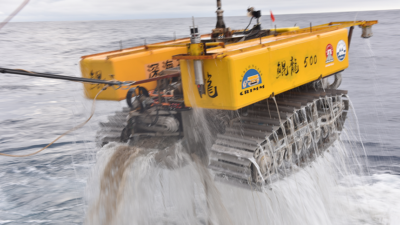
The winter recovery was, according to JAMSTEC, the first continuous lift of rare-earth-bearing mud from that depth to a surface vessel anywhere in the world. The mission ran from January 11 to February 14, with the first mud reaching the vessel’s deck on February 1. Shoichi Ishii, who directs the project under the Cabinet Office’s Cross-ministerial Strategic Innovation Promotion Program, SIP, said the team has established technology for continuously lifting rare earth mud from the deep seabed to a ship while limiting disturbance to the seafloor ecosystem.
Why it matters
Minamitorishima is Japan’s easternmost territory, a coral atoll about 1,900 kilometers southeast of Tokyo. The deposit lies entirely within Japan’s exclusive economic zone, so the project requires no license from the International Seabed Authority and is unaffected by the legal uncertainty surrounding nodule projects in international waters.
The composition matters as much as the location. Heavy rare earths are the segment of the market where Chinese control is most complete. Beijing placed export controls on seven medium and heavy rare earth elements, including dysprosium and yttrium, in April 2025. After relations with Tokyo deteriorated late last year, shipments of dysprosium and terbium oxide to Japan stopped in November 2025, and on January 6, 2026 China banned exports of dual-use items to Japanese military end users. A deposit in which more than half of the rare earth content is medium and heavy elements addresses the most exposed part of Japan’s supply chain.
Tokyo has spent about 40 billion yen, roughly 250 million dollars, on the program since 2018.
Background
A 2018 study led by Yasuhiro Kato of the University of Tokyo estimated that the mud around Minamitorishima holds more than 16 million tons of rare earth oxides, enough to meet global demand for some heavy rare earths for centuries. Since then the main question has been whether mud can be lifted economically from 6,000 meters, deeper than the 4,000 to 5,500 meter nodule fields of the Clarion-Clipperton Zone.
The program is also drawing in Washington. During President Donald Trump’s visit to Tokyo in late October 2025, the two governments signed a framework agreement on securing rare earth supplies, and on November 6, 2025 Prime Minister Sanae Takaichi said Japan and the United States will jointly study rare earth development around Minamitorishima.
What to watch
- February 2027: the full-scale recovery test off Minamitorishima, targeting up to 350 metric tons of mud per day.
- Alongside the test: dewatering of recovered mud at Minamitorishima, with separation, refining and smelting planned for mainland facilities.
- March 2028: the government’s feasibility assessment of domestic rare earth production is due.
- Scale-up: Japanese press reports citing program estimates put commercial-scale recovery at roughly 3,500 tons of dry mud per day, ten times the 2027 target.