Key points
- Japan dispatched the drilling vessel Chikyu on a month-long expedition to test recovery of rare earth rich seabed mud near Minamitori Island, about 1,900 kilometers southeast of Tokyo.
- The campaign aims to continuously lift material from roughly 6 kilometers water depth; Chikyu sailed with 130 crew and researchers and is scheduled to return February 14.
- The push follows China’s tightening rare earth export controls, after Japan cut its reliance on China from about 90% to roughly 60% since a 2010 export restriction episode.
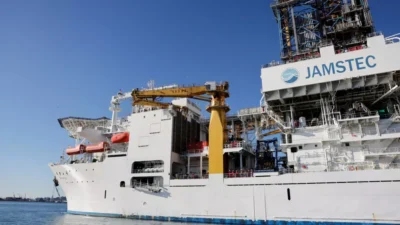
Japan has dispatched its drilling equipped research vessel Chikyu on a month long expedition to test recovery of rare earth rich seabed mud near Minamitori Island, a remote coral atoll roughly 1,900 kilometres southeast of Tokyo. The campaign is being framed as the world’s first attempt to continuously lift rare earth bearing material from approximately 6 kilometres water depth to a ship.
The government backed project is designed as a confirmation test after years of preparation. Project leader Shoichi Ishii said, “After seven years of steady preparation, we can finally begin the confirmation tests. It’s deeply moving.” He added, “If this project succeeds, it will be of great significance in diversifying Japan’s rare earth resource procurement,” and described recovery from that depth as a major technological milestone.
Chikyu sailed from Shizuoka with 130 crew and researchers and is scheduled to return on February 14. The departure underscores Tokyo’s urgency in building alternative supply lines for minerals critical to cars, smartphones, and defence technologies, as China applies fresh pressure on trade in strategically sensitive materials.
Japan’s push comes amid rising concern that Chinese export controls could expand beyond narrowly defined dual use restrictions. China recently announced measures affecting exports of items destined for Japan’s military that have both civilian and military applications, including some critical minerals. Reporting has also indicated Beijing may be considering broader limits on rare earth exports to Japan, a step that would heighten risk for manufacturers that depend on predictable flows of magnet metals and other specialty inputs.
Japan has experienced this vulnerability before. In 2010, China restricted rare earth exports following an incident near disputed islands in the East China Sea. Since that episode, Japan has reduced its reliance on China to roughly 60 percent from about 90 percent by investing in overseas projects and processing capacity, promoting recycling, and encouraging manufacturing methods that use fewer rare earths.
Even with diversification, analysts continue to flag heavy rare earth exposure as a structural weak point. For certain heavy rare earths used in high performance magnets for electric and hybrid vehicle motors, Japan remains close to fully dependent on China, a strategic risk for the country’s automotive supply chain.
The Minamitori Island program is Japan’s first attempt to source rare earths domestically from the seabed. Takahide Kiuchi, executive economist at Nomura Research Institute, said, “The fundamental solution is to be able to produce rare earths inside Japan.” He added, “If this new round of export controls ends up covering a lot of rare earths, Japanese companies will again make efforts to move away from China, but I don’t think it will be easy.”
The initiative is a long term play. The Japanese government has invested about 40 billion yen since 2018. Estimated reserves have not been disclosed and no production target has been set. If the confirmation tests are successful, the next step would be a full scale mining trial scheduled for February 2027.
Historically, mining rare earth rich mud has been viewed as uneconomical because of high costs, especially given the technical challenge of lifting material from extreme depths and processing it into usable rare earth products. However, the economics could shift if supply disruption persists and end users are forced to accept higher prices to secure non China supply.
The project is proceeding under close regional scrutiny. During surveys around the island last year, Chinese naval vessels operated nearby, according to Ishii, who said, “We feel a strong sense of crisis that such intimidating actions were taken.” China has said its actions were consistent with international law and called on Japan to “refrain from hyping up threats.”
For Japan, the Chikyu mission is a test of both engineering and strategy. Success would not immediately solve the rare earth challenge, but it would demonstrate a credible domestic option and a technological pathway that could reduce exposure to geopolitical supply shocks over time.