Key points
- Mengxiang was designed by the 708 Research Institute of China State Shipbuilding Corporation and built by Huangpu Wenchong, with the naming and first sea trial on December 18.
- The vessel has a gross tonnage of about 33,000, length 179.8 meters, beam 32.8 meters, range 15,000 nautical miles and can drill to 11,000 meters.
- Led by the China Geological Survey with more than 150 participating organizations, it broke through more than 10 key technologies including an independently developed riserless mud recovery system.
- Onboard laboratories total more than 3,000 square meters; full completion is expected in 2024.
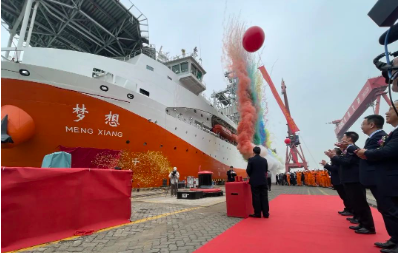
On December 18, the Mengxiang (Dream), an ultra-deepwater scientific drilling vessel designed by the 708 Research Institute of China State Shipbuilding Corporation (CSSC) and built by Huangpu Wenchong, held its naming ceremony and first sea trial, marking a key step in the development of China’s deep-sea exploration capability and marine technology equipment.
The Mengxiang is expected to be fully completed in 2024. After delivery it will mainly undertake ocean scientific drilling missions under major national science and technology projects and international large-scale science programs.
Ultra-deepwater scientific drilling is regarded as the crown of marine science and technology. The Mengxiang not only opens a new chapter in the development of China’s marine science and technology, it will also help realize the ambition of scientists worldwide to drill through the Mohorovicic discontinuity and reach the upper mantle, raising humanity’s capabilities in deep-sea access, deep-sea exploration and deep-sea development.
Leading technology
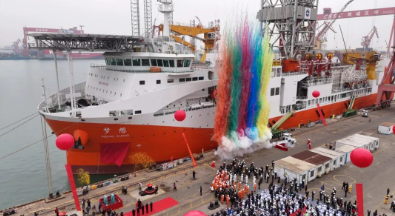
The vessel has a gross tonnage of about 33,000, an overall length of 179.8 meters, a beam of 32.8 meters and a range of 15,000 nautical miles. It can withstand category 16 typhoon sea conditions and has a drilling capability of 11,000 meters in ocean areas.
The vessel is a major national science and technology innovation project led by the China Geological Survey of the Ministry of Natural Resources, designed and built by CSSC, with more than 150 organizations participating in research and construction. Following a design and construction concept of small tonnage, multiple functions and modularization, the Mengxiang achieved a number of international firsts and broke through more than 10 key technologies.
The vessel carries the world’s most advanced drilling system, with two operating modes covering oil and gas drilling and ocean scientific drilling. Its deepwater riserless mud recovery (RMR) system was independently developed in China, taking the country from having no capability in this field to having its own system.
The vessel has onboard laboratories with a total area of more than 3,000 square meters, fitted with a world-class magnetic shielding room, ultra-clean laboratory space and the world’s first shipboard automated core transfer and storage system, meeting research requirements across all ocean disciplines.
It also has an integrated research vessel information system that uses more than 20,000 monitoring points throughout the ship to enable whole-process monitoring of drilling and production operations and intelligent coordination of scientific experiments.
In addition, the vessel applies a latest-generation 30 megawatt closed-loop ring power grid and battery energy storage technology, substantially improving economy and reliability and cutting energy consumption by more than 15%.
Carefully built
The Mengxiang is also one of the most complex vessels to build. During its development, CSSC used the project to lead and drive research and development of key deep-sea technologies and equipment, achieving a series of important breakthroughs in that field and turning a major national asset and super project from blueprint into reality.
The participating organizations will continue to focus on completing the remaining construction and support work for the Mengxiang to a high standard, aiming for early delivery of a vessel intended to unlock the resources of the deep sea for the benefit of humanity.