Key points
- Study published in the Yale Journal of Industrial Ecology, commissioned by TMC, released January 31, 2022
- Nodule-based nickel, copper, cobalt and manganese production could cut lifecycle solid waste 59 to 93% versus land ores
- Land ores generate over 270 kg of waste per kg of nickel and 460 kg per kg of copper, versus 83 kg and 29 kg from nodules
- Model was based on supplying one billion 75kWh EV batteries using an NMC 811 cathode chemistry
- Peer-reviewed researchcommissioned by The Metals Company and published in the- Yale Journal of Industrial Ecologyfinds that producing four key battery metals (nickel, copper, cobalt, manganese) from seafloor polymetallic nodules could reduce lifecycle solid waste by 59-93% compared to land ores.
- Researchers modelled solid waste streams over the lifecycle of metal production, including mining, processing and refining, using a wide range of production pathways for both land ores and nodules.
- Their analysis shows that producing electric vehicle (EV) battery metal feedstocks from land ores would on average generate over 270 kg of waste per every kg of nickel and 460 kg of waste per every kg of copper while nodule-derived values would be 83 and 29 kg of waste, respectively.
- Booming demand for energy transition metals and a historic decline in ore grades on land have led to increased growth of solid waste streams which are likely to intensify as terrestrial mining continues its expansion into forested carbon sinks.
- Polymetallic nodules lie unattached on the seafloor in the Clarion Clipperton Zone (CCZ) and contain high grades of four metals in a single ore, no toxic levels of heavy elements, and can be collected without digging, drilling or blasting.
NEW YORK, Jan. 31, 2022 (GLOBE NEWSWIRE) — As the world faces a myriad of challenges in transitioning to clean energy, new research shows that seafloor polymetallic nodules could help meet massive new demand for EV battery metals like nickel while significantly reducing — and in some scenarios eliminating — the solid waste streams typically generated by metal production from land ores.
Published in the Yale Journal of Industrial Ecology, the new peer-reviewed study starts with a demand scenario of producing four metals (nickel, cobalt, manganese, copper) to supply one billion 75KWh EV batteries with a cathode chemistry of NMC 811 (80% nickel, 10% manganese, 10% cobalt). It then compares the solid waste streams generated during the production of these four metals from two sources: conventional ores found on land and polymetallic nodules with high concentrations of four metals in a single ore found on the seafloor of the Clarion Clipperton Zone (CCZ) of the Pacific Ocean.
Daina Paulikas of the University of Delaware’s Minerals, Materials and Society Program, said: “Over the past three years, my co-authors and I have undertaken a series of systems-based analyses considering comparative impacts of metals produced using seafloor nodules vs. land-based ores, including a peer-reviewed study on climate change impacts which noted up to a 90% reduction when sourcing metals from nodules. In our new publication, we set out to map the waste streams that may be expected as the world rushes to source metals to decarbonize our energy and transport systems, and to provide an integrated assessment of the risks that such waste flows entail.”
A photo accompanying this announcement is available at https://www.globenewswire.com/NewsRoom/AttachmentNg/7ff427c0-f432-4a4a-9d42-9722c5bfdeab
Paulikas and co-author Dr. Steven Katona from the College of the Atlantic, added: “Overall, our combined quantitative and qualitative systems analysis — which included quantification and allocation of waste streams followed by a qualitative risk assessment for each waste stream — implies that the waste streams generated by nodules should be significantly smaller, and in most cases of lower overall impact, with the exception of seafloor and midwater sediment plumes whose effects are still under scientific investigation.”
Production of energy transition metals will need to increase six-fold by 2040 to meet the world’s ambitious climate targets, according to the International Energy Agency. The mining industry is already the single largest source of industrial waste on the planet. Meeting these goals would generate more than a six-fold increase in solid waste streams due to the continued decline in ore grades on land. The overall impact of these waste streams would likely become more severe as mining of metals like nickel is expanding into places with extreme biodiversity like the rainforests of Indonesia and the Philippines — the two countries where according to analysts most new nickel supply will come from in the coming decades.
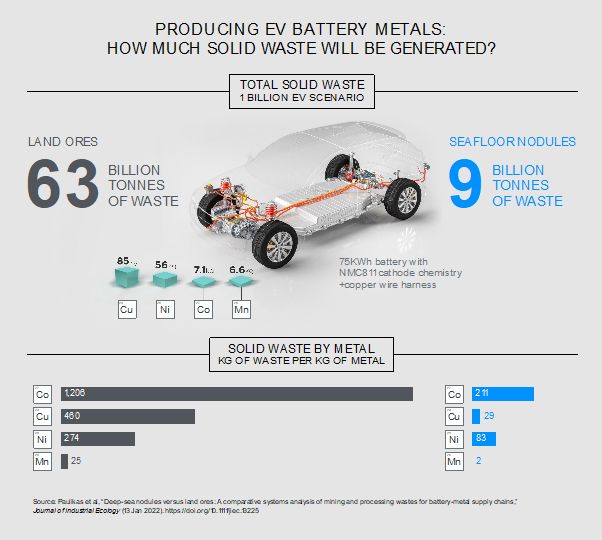
Waste generation for a single EV
The researchers noted that every kilogram of class I nickel mined and produced today can result in between 50 to 160 kg of potentially toxic tailings that must be managed indefinitely. Production of nickel, cobalt, copper and manganese for a single EV with a 75kWh battery creates 40 to 61 metric tons of waste, around 50% of which is tailings. Over the next 20 years, this range is estimated to average 50-75 metric tons as copper and nickel ore grades continue to decline. The research suggests that using CCZ polymetallic nodules to produce battery metals over the next 20 years could reduce per-EV waste by 59 to 93%, including a 79 to 96% reduction in tailings.
Modelling a range of processing flowsheets – from near zero to very high solid waste — the researchers found that nodules delivered much smaller waste outputs, thanks in large part to the presence of high grades of four metals in a single ore and an absence of toxic levels of heavy elements that enables the design of metallurgical flowsheets with near-zero solid waste.
As concerns grow regarding the environmental and social implications of land-based mining and processing tailings — often toxic waste that must be contained inside engineered dams indefinitely, dry-stacked and protected or disposed of in the ocean — the massive deposit of polymetallic nodules in the CCZ offers a pathway to greatly reduce the waste footprint of the clean energy transition. Researchers note that while there is no overburden to remove from the abyssal plain to access the polymetallic nodule resource, the collection of nodules disturbs seafloor sediment and the resulting sediment plume has been treated as a waste stream.
“Our systems analysis included quantification of the expected amount of sediment plumes, both at the seafloor and at the point of reinjection of seawater used for nodule transport in the riser (~1000 m below sea level or deeper), because disruption of this mass is a cause of concern for harming species and habitats of the abyssal seafloor and the midwater column,” added Dr. Katona. “In our analysis, sediment plume is the single biggest waste stream that would be generated by metal production from nodules. As more research institutions and polymetallic nodule companies perform their collector tests and publish their research and Environmental Impact Statements, it will be possible to further refine our quantifications of plumes and better characterize their impacts.”
About The Metals Company
TMC the metals company Inc. (The Metals Company; TMC) is an explorer of lower-impact battery metals from seafloor polymetallic nodules, on a dual mission: (1) supply metals for the clean energy transition with the least possible negative environmental and social impact and (2) accelerate the transition to a circular metal economy. The company through its subsidiaries holds exploration and commercial rights to three polymetallic nodule contract areas in the Clarion Clipperton Zone of the Pacific Ocean regulated by the International Seabed Authority and sponsored by the governments of Nauru, Kiribati and the Kingdom of Tonga. More information about The Metals Company is available at www.metals.co.