Key points
- Scientists from USGS, the University of California Santa Cruz, Oregon State University and Scripps Institution of Oceanography studied how ferromanganese crust composition varies along west-central Pacific seamounts.
- They measured element concentrations in the uppermost layer, less than 15 millimeters, of 57 crusts spanning 30 degrees of latitude.
- Seawater oxygen content, detrital input, surface productivity and deep sources of iron are all clearly recorded by the crusts.
- The results can be used to define regions of interest for ferromanganese crust exploration.
First detailed, large-scale study of parameters that control ferromanganese crust composition on seamounts in the west-central Pacific Ocean

Scientists from the USGS, the University of California Santa Cruz, Oregon State University, and Scripps Institution of Oceanography published a detailed study of how the composition of ferromanganese (FeMn) crusts varies along seamounts spanning 30° of latitude in the west-central Pacific. They evaluated the concentrations of elements (e.g,. manganese—Mn, iron—Fe, cobalt—Co, nickel—Ni, molybdenum—Mo, zinc—Zn, silicon—Si, aluminum—Al, barium—Ba, magnesium—Mg) from the uppermost layer (less than 15 millimeters) of 57 FeMn crusts for statistically significant variance and correlation with a variety of oceanographic and geographic parameters. Fluctuations in seawater oxygen content, detrital input, surface productivity, and deep sources of iron are clearly recorded by FeMn crusts. Modern measurements of these primary parameters, as well as paleoceanographic reconstructions, can be used to define regions of interest for FeMn crust exploration.
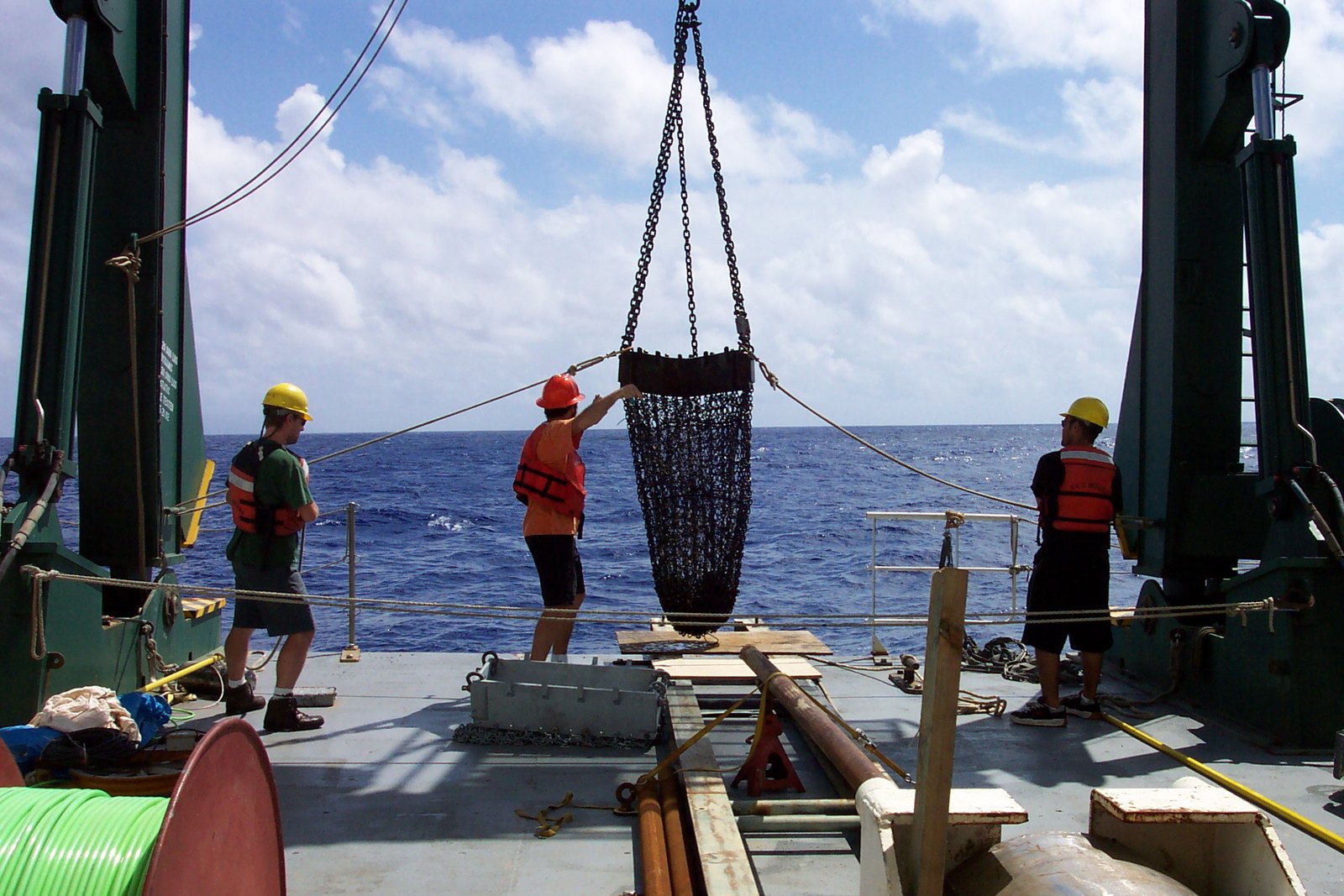
Mizell, K., Hein, J.R., Lam, P.J., Koppers, A.A.P., and Staudigel, H., 2020, Geographic and oceanographic influences on ferromanganese crust composition along a Pacific Ocean meridional transect, 14 N to 14 S: Geochemistry, Geophysics, Geosystems, v. 21, e2019GC008716, https://doi.org/10.1029/2019GC008716