Key points
- Namibia’s Environmental Commissioner notified NMP on 6 August 2026 of the decision to issue a clearance certificate for ML 170.
- The certificate is valid for three years from the date of issue.
- NMP says the grant does not mean mining begins, with monitoring programmes and terrestrial permitting still outstanding.
- Oversight runs through a government-led structure chaired by the Commissioner plus a Marine Environmental Scientific Advisory Committee.
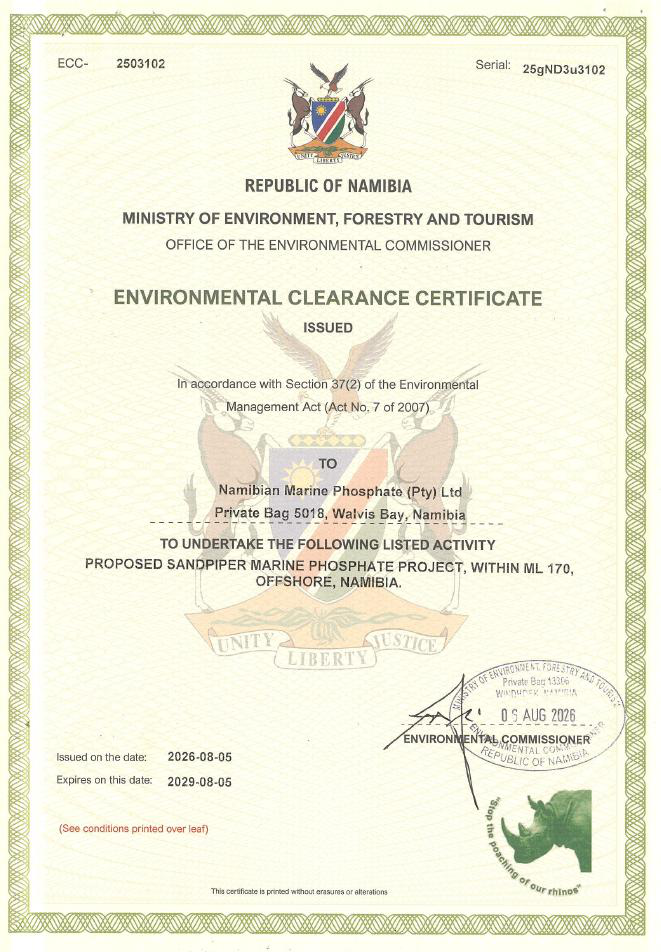
Namibian Marine Phosphate (Pty) Limited (“NMP”) wishes to advise that on 6 August 2026, Namibia’s Environmental Commissioner (“EC”) notified NMP, and the Competent Authority, of his decision to grant the application and issue an Environmental Clearance Certificate (“ECC”) for Mining Licence 170 (“ML 170”) and the Sandpiper Marine Phosphate Project (“Sandpiper Project”). The ECC is valid for 3 years from the date of issue.
Notification of the EC’s decision has been issued to all stakeholders and registered Interested and Affected Parties (“I&APs”) by the appointed Environmental Assessment Practitioner (“EAP”).
Next Steps:
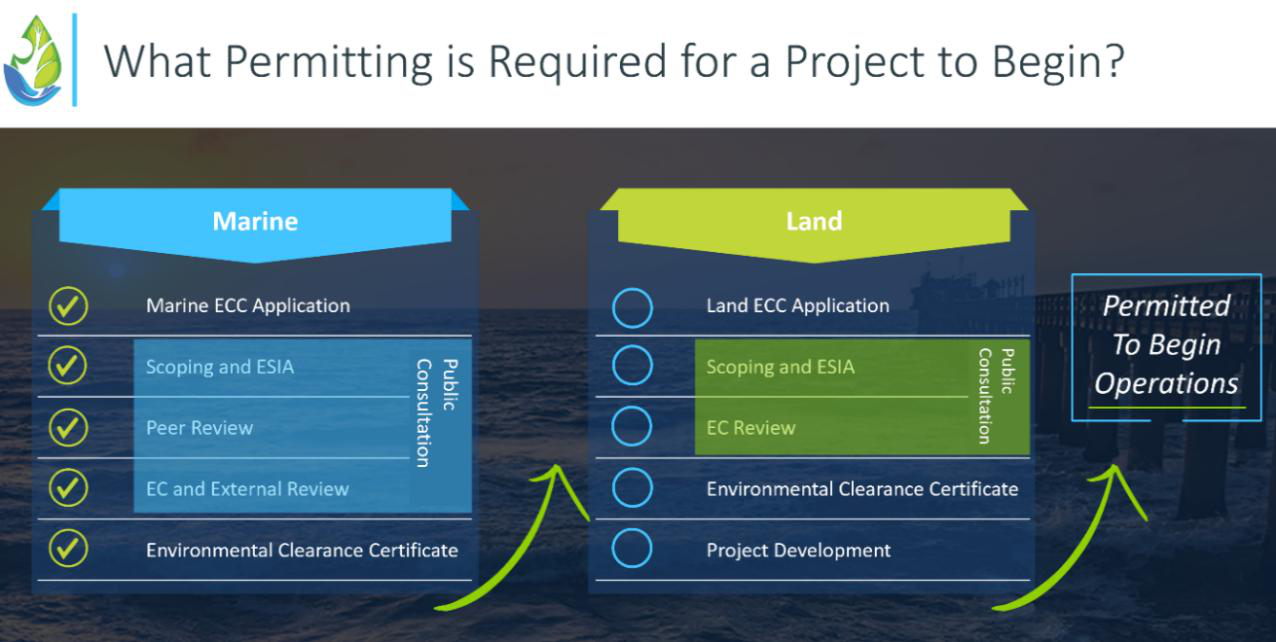
- No immediate mining – The granting of the ECC does not signify immediate commencement of mining operations within ML 170. The project remains subject to:
- Implementation of the detailed monitoring programs in line with the Environmental and Social Management Program (“ESMP”).
- Completion of additional permitting processes for the terrestrial component of the project.
- ML 170 (ECC Conditions) – NMP will implement marine environmental monitoring activities in accordance with the ESMP and conditions of the ECC, including:
- A government-led oversight structure, chaired by the EC, will regulate mining activities, supported by independent expert review, with monitoring, baseline validation, and impact assessment independently verified.
- A multi-sectoral Marine Environmental Scientific Advisory Committee (“MESAC”), modelled on other marine mining entities such as De Beers, will advise on the performance of the ESMP.
- A copy of the Environmental Clearance Certificate is available from the Ministry of Environment, Forestry and Tourism.
- As such, no immediate or urgent commercial operations are planned by NMP.
About the Sandpiper Project:
The Sandpiper Project is a pelletal-phosphorite resource located in the seabed sediments on Namibia’s continental shelf, in water depths of 180 – 250m. The resource has the scale to support long-term mining and beneficiation, underpinning the production of fertilizer products and the development of a phosphate-based industry in Namibia.
Subject to permitting, operations are expected to involve controlled dredging within a small part of ML 170, at depths of 200 – 250m, with onshore processing to produce approximately 3 million tonnes per year of phosphate concentrate. Mining will cover around 1.7 km2 (0.1% of ML 170) annually, on average, which represents 34 km2 over 20 years, equivalent to 1.5% of ML 170 and 0.002% of the seabed in Namibia’s Exclusive Economic Zone.