Key points
- NMP argues marine diamond mining dredges the same environment on a larger scale without comparable opposition.
- The company says fishing and marine diamond mining already co-exist in Namibian waters.
- It describes the seabed and environmental impacts of diamond and phosphate dredging as essentially the same.
- NMP says its industry remains held up by public emotion, legal action and bureaucratic delay.
The development of the marine phosphate industry in Namibia continues to be hamstrung by public emotion, legal action and bureaucratic delays. Yet, the marine diamond industry continues to flourish in the same marine environment, eco-system and using dredging on a larger scale unopposed. Why is this double standard allowed to persist?
Facts
The marine diamond industry is expanding in the marine environment Fishing and marine diamond mining co-exists. Marine mining for diamonds and phosphate both utilise forms of seabed dredging. Seabed and environmental impacts of both operations are essentially the same but to a different scale. Marine diamond mining impacts a significantly larger area and affect greater expanses of the ocean floor ecosystems than the envisaged phosphate mining activities.
Diamonds The announced expansion of Marine Diamond Mining in Namibia received unilateral support from most ministries in Government. Contrary to the outcry against the establishment of a new marine phosphate industry, there was also no formal resistance, objections or legal injunctions from the fishing industry as a whole to the planned expansion of Marine Diamond Mining in Namibia.
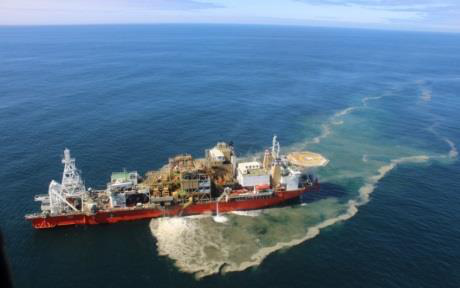
Namdeb Marine Diamond Mining Vessel (Crawler)
The rationale for the lack of opposition presumably is a matter of economics. The diamond industry (as Namdeb) is the largest single contributor to the Namibian GDP at around 9%. The imminent closure of 4 major coastal diamond mines means that in future, up to 95% of annual diamond production will be derived from seabed mining. In June 2017, the Minister of Mines and Energy, declared at the launch of the worlds most advanced marine diamond exploration vessel, the N$2.3 billion MV “SS Nujoma” that this is “the largest ever capital investment in underwater diamond mining and will ensure a long-term, sustainable future for offshore diamond mining in Namibia, as well as creating important new jobs for Namibians.”
29 Temple Crescent Road, Meersig, Walvis Bay
Walvis Bay Tel: +264 64 278150 Fax: +264 64 200290 E-mail: info-namphos@namphos.com
Phosphate
In stark contrast to marine diamonds, for the past 5 years the opportunity to develop a new marine phosphate industry in the same marine environment has, been frustrated and delayed by unsubstantiated, emotively charged resistance from the fishing industry and self-styled environmental activist groups. These same parties have failed to utter a single word to oppose the expansion of the marine diamond industry. Why this double standard and hypocrisy? Marine diamond mining and the envisaged phosphate mining would operate in the same environment. Isn’t what is good for the goose, no longer good for the gander? We want to believe that just like the marine diamond industry, the phosphate industry is premised on the sustainable harvesting of Namibia’s natural resources in order to significantly contribute to Namibia’s GDP and create employment opportunities. Namibia marine Phosphate will go even further to practically economically empower previously disadvantaged communities in Namibia, starting with the residents of the coastal areas.
Food for thought
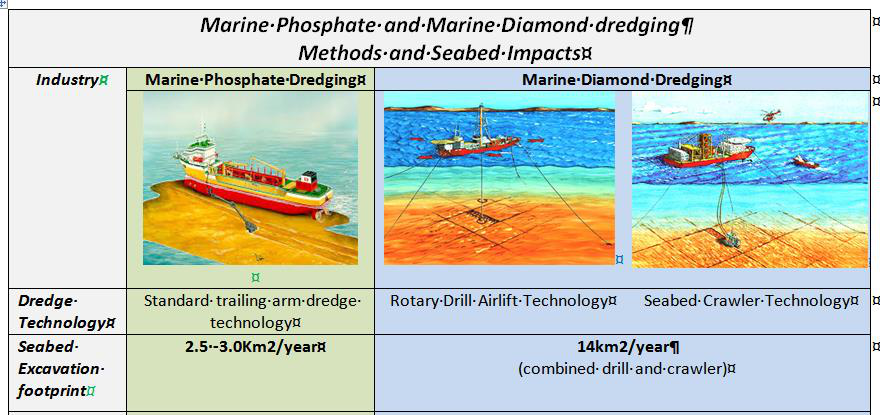
It is an undeniable fact that seabed mining for diamonds and phosphate both utilise forms of seabed dredging, involving the removal of surface seabed sediments, with fine sediment discharge overboard. Seabed mining methods used in the two processes are effectively the same, however, diamond operations have a significantly larger annual footprint than phosphate mining.
The main differences between the two comparable industries are:
Scale of operations – the annual footprint for phosphate mining is 1/5th (3km2) of the size of diamond dredging and; Limits of excavation – phosphate dredging does not excavate the sediments to expose the footwall/hard substrate whereas diamond dredging does.
For the past 15 years or more, Namdeb have been conducting marine diamond mining operations and keeping environmental records. These record show that there is no recorded significant damaging
29 Temple Crescent Road, Meersig, Walvis Bay
Walvis Bay Tel: +264 64 278150 Fax: +264 64 200290 E-mail: info-namphos@namphos.com
impacts on the seafloor environment and ecosystem as a result of marine diamond mining operations. If there were any, then the Fishing Industry and anti-seabed mining groups would have objected and Government would have been compelled to act in accordance with appropriate regulations to suspend or terminate the Namdeb seabed mining activities in order to protect the natural environment. No such action has ever been taken to date and Namdeb’s seabed mining operations are set to expand in coming years.
Given that marine diamond mining
co-exists with commercial fishing is fully sanctioned by Government and it is unopposed by fishing industry or anti-seabed mining groups, then what is the justification for the virile opposition and “fear-mongering” surrounding marine phosphate mining, which amounts to hypocrisy and holding similar situations to different standards?
It is apparent that in this case, while all parties have confidence in the Government’s vision and capacity to manage the expansion of marine diamond mining for the betterment and good of the Nation as a whole and that the benefits outweigh the costs, they do not have the same confidence in Government to manage development of a sustainable phosphate industry on the same basis and under the same legislative framework.
Closing Statement
Phosphate exploration or mining has not been imposed on Namibia.
The Namibian government openly invites foreign investment in the mineral sector and has approved the licenses to explore for minerals and develop new mines, which is the primary objective of any exploration.
In their 2016 annual report the Chamber of Mines notes that “The mining industry remains the backbone of the Namibian and opens new opportunities to the wider economy as the country is now reaping the benefits of new investments and re-investments with three new mines in production”.
To this end, exploration spending by operating and exploration companies in 2016 was N$510.92 million. It is also why Namdeb have invested so heavily in new marine diamond exploration with the launch of the N$2.3 billion MV “SS Nujoma”
In response to the invitation by the Government of Namibia (GRN), since 2008 NMP shareholders have invested more than N$780 million into the development of the marine phosphate exploration and mining licenses issued by GRN to NMP.
29 Temple Crescent Road, Meersig, Walvis Bay
Walvis Bay Tel: +264 64 278150 Fax: +264 64 200290 E-mail: info-namphos@namphos.com
Furthermore, phosphate is valued as a vital nutrient for food security. Namibia’s diamonds are valued as a luxury goods item for the jewelry industry. It is our belief that on the basis of fairness, objectivity and a level playing field, alongside other ocean based extractive industries such as diamonds and fish, there is no doubt that the development of a sustainable phosphate industry could create significant additional economic and employment benefits that Namibia so urgently requires.
Countries, both large and small, around the world that do have commercially viable resources of phosphate are managing the optimal development thereof as a strategic resource due to its fundamental significance to food security. For example, Jordan is developing it phosphate resources into a fully integrated phosphate industry with strong government support and benefit to the national economy.
We urge against unfairness and double standards in favour of objectivity and scientific empirical evidence to be the basis on which the viability of the phosphate mining industry in Namibia is assessed. Motives and justifications to oppose and deny Namibia the opportunity to benefit from this natural resource MUST interrogated and understood, free from emotions.
***
29 Temple Crescent Road, Meersig, Walvis Bay
Walvis Bay Tel: +264 64 278150 Fax: +264 64 200290 E-mail: info-namphos@namphos.com