Key points
- TMC concluded Environmental Expedition 5C, part of a $75 million multi year environmental baseline research program
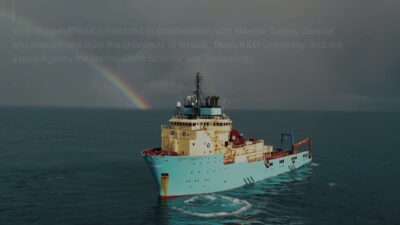
- Conducted with Maersk Supply Service and researchers from the University of Hawaii, Texas A&M and JAMSTEC
- Achieved a world first, sampling pelagic biota at 4,000 meters depth via the first deep MOCNESS net tow in the Eastern Tropical Pacific
- Completed 100% of the work program despite six meter swells with no safety incidents; Expedition 5E, the fifth and final 2021 campaign, has since begun
–
The Metals Company has successfully concluded Environmental Expedition 5C, the latest campaign in its$75 million multi-year deep-sea research program to establish a rigorous environmental baseline and characterize the potential impacts of the Company’s proposed nodule collection operations
–
In collaboration with Maersk Supply Services and researchers from the University of Hawaii ,Texas A&M University and theJapan Agency for Marine-Earth Science and Technology (JAMSTEC), the Company achieved a world first by successfully sampling pelagic biota at depths of 4,000 meters, marking the first deep MOCNESS net tow in theEastern Tropical Pacific Ocean
- Facing six-meter swells at times, the team endured significant challenges to successfully complete 100% of the work program on schedule and with an untarnished safety record
This press release features multimedia. View the full release here: https://www.businesswire.com/news/home/20211108005628/en/
Researchers from the 2 MOCNESS system (Multiple Opening/Closing Net and Environmental Sensing), comprising a series of nets with varying mesh sizes that open and close at controlled depths in the water column to capture a profile of biological communities at each depth layer. In collaboration with Maersk Supply Services, the team was able to trigger these nets to retrieve biological samples at a depth of 4,000 meters providing a glimpse into the deep-sea communities that may inhabit the dark, high-pressure regions of the
“We hear the call for further research into the impact of collecting deep-sea nodules and since 2011 we have been doing just that,” said
Alongside the MOCNESS system, researchers leveraged hydrographic rosettes to determine the physical properties of the water column, generating insights into local salinity, temperature, oxygen, turbidity, nutrient profiles and trace metal content, which will help characterise the inter-relationships between the physical environment from the surface to the abyssal depths, and the animals that live there.
Facing rough seas with swells as high as six meters, both the logistics and research teams overcame significant challenges to complete the scope of the work program on time and without any accidents or incidents. Mobilization of Environmental Expedition 5E, the company’s fifth and final research campaign of 2021, has now commenced and is expected to be completed before the new year. Expedition 5E will mark the completion of the offshore campaigns that will form the basis of the Company’s environmental baseline work.
Planet’s Largest Known Source of Battery Metals
As countries invest in large-scale clean energy transition programs and begin to phase out internal combustion engines, hundreds of millions of tons of critical battery metals including nickel, cobalt, copper and manganese will be needed to decarbonize the world’s energy and transport systems. In the
TMC’s NORI-D nodule project – recently ranked as the #1 nickel project in the world by Mining.com — is the first in the Company’s project development pipeline. In January,
About The Metals Company
TMC the metals company Inc. (www.metals.co.